
6 best plug-in wall sconces for 2026

Best overall: swing-arm plug-in sconces. Best for bedside reading: directional reading sconces. Best for soft evening light: shaded fixed-arm sconces. This 2026 guide compares six styles of plug in wall light sconces by how you use the room, rather than presenting unverified products as plug-in models.
TL;DR
- Choose swing-arm plug in wall light sconces when you need adjustable light beside a sofa or chair.
- Choose directional reading sconces for focused bedside light; choose shaded sconces for softer room lighting.
- Lighthouseco shoppers should confirm plug-in wiring, cord length, switch location, and mounting instructions before choosing a wall sconce.
- A wall-mounted fixture is not automatically plug-in, and a plug-in fixture still needs secure mounting.
Why this matters
A wall sconce frees up a tabletop, but the wrong shade or switch position creates a different problem: light in your eyes or a control you cannot comfortably reach. Start with the activity, then choose the shape.
When exploring Lighthouseco, distinguish a fixture's appearance from its electrical connection. A product described as a wall sconce still needs explicit plug-in confirmation before it belongs on your shortlist.
For your 2026 room update, plan the outlet and visible cord alongside the furniture. Those details affect the finished arrangement just as much as the metal finish.
What makes the best plug-in wall light sconces?
Use these six checks before comparing decorative details:
- Confirmed connection: Look for an explicit plug-in designation and manufacturer installation instructions. A photograph alone does not establish wiring type.
- Useful light direction: Match adjustable light to changing tasks, focused light to reading, and indirect light to background illumination.
- Comfortable shielding: Check whether you can see the bulb from your usual seated or lying position.
- Reachable controls: Identify the switch location before deciding where the backplate belongs. Check dimming compatibility separately.
- Practical cord route: Measure the actual route to the outlet, including turns around furniture, rather than measuring a straight diagonal.
- Secure mounting: Follow the supplied mounting requirements for the wall construction. Plug-in power does not mean adhesive or damage-free installation.
Choose the light pattern first and the finish second. A beautiful sconce that shines into your eyes is the wrong fixture for that position.
Plug-in wall sconce styles at a glance
These are style recommendations, not claims that a particular retailer's model has a plug-in connection. Confirm the electrical specifications of the exact fixture you choose in 2026.
| Rank and style | Best for | Standout feature to seek | Key limitation |
|---|---|---|---|
| 1. Swing-arm sconce | Flexible lighting beside seating | An arm that brings light toward the task | Needs clearance throughout its movement |
| 2. Shaded fixed-arm sconce | Soft bedroom or living-room light | A shade that shields the bulb | Offers limited repositioning |
| 3. Directional reading sconce | Focused bedside reading | An aimable head and reachable control | Does not replace general room lighting |
| 4. Uplight sconce | Indirect evening illumination | Light directed toward the upper wall | Wall and ceiling surfaces affect the result |
| 5. Double-arm sconce | A decorative focal point | Two light-bearing arms on one backplate | Needs more visual and physical space |
| 6. Picture-style sconce | Illuminating wall art | An elongated head positioned above artwork | Requires careful alignment to limit reflections |
1. Swing-arm: best plug-in wall sconce for flexible seating
A swing-arm sconce lets you move the light closer to a book, chair, or end of a sofa. Choose a model whose manufacturer confirms the arm's movement and adjustment points; not every joint in a decorative fixture moves.
This is the strongest default when your seating has more than one purpose. You can position the light for reading, then move it back toward the wall when you finish.
Swing-arm pros:
- Moves light toward the activity rather than requiring you to move furniture.
- Keeps the side table free for everyday objects.
- Suits a chair that serves both reading and conversation.
Swing-arm cons:
- The extended arm needs clear space around it.
- Moving parts require access and adjustment.
- An exposed bulb can create glare as the arm changes position.
Before mounting, mark the arm's intended resting and working positions with removable tape. Check both from the doorway and from the chair, especially if people walk behind the seating.
Best for: A reading chair or sofa corner with changing lighting needs.
Verdict: Buy a confirmed plug-in swing-arm model when flexibility matters most.
2. Shaded fixed-arm: best plug-in wall sconce for soft evening light
A shaded fixed-arm sconce brings the familiar shape of a table lamp onto the wall. The shade controls where light escapes, while the fixed arm gives the fixture a consistent position.
Choose this style when you want a welcoming bedside or living-room arrangement rather than a light you reposition throughout the evening. Inspect the shade opening from the position where you will actually sit.
Shaded fixed-arm pros:
- A suitable shade shields direct views of the bulb.
- Works as a decorative element even when switched off.
- Creates a consistent arrangement beside furniture.
Shaded fixed-arm cons:
- A fixed arm cannot follow a changing reading position.
- Shade material and opacity change the light distribution.
- A projecting shade needs clearance from curtains and furniture.
For a 2026 bedroom refresh, start with a warm-white bulb around 2700 K, where the fixture accepts a replaceable bulb and its instructions permit your choice. Color temperature describes the appearance of the light, not its brightness.
Best for: Bedrooms and living rooms where background light takes priority over precise task lighting.
Verdict: Buy for soft evening lighting; skip as your only reading light unless the placement works.
3. Directional reading: best plug-in wall sconce for bedside tasks
A directional reading sconce concentrates light where you aim its head. Unlike a broad shaded fixture, its main job is to illuminate a book or another close task.
The important detail is the relationship between your pillow, the light head, and the switch. A compact fixture still fails if you must sit up and stretch every time you want to turn it off.
Directional reading pros:
- Directs illumination toward the reading area.
- Leaves the nightstand clear.
- Lets you prioritize task lighting over decorative scale.
Directional reading cons:
- A focused beam does not provide full-room illumination.
- Poor aiming can put light into another sleeper's eyes.
- A narrow beam requires accurate placement.
Sit in your normal reading position before marking the wall. Have someone hold a paper outline of the fixture in place, then check the manufacturer's adjustment range against the position you need.
A 3000 K light is another warm-white option to compare with 2700 K. Choose between them by the atmosphere you prefer, not by assuming a higher Kelvin value means more light.
Best for: Bedside reading with a dedicated light for each reader.
Verdict: Buy for focused reading; skip as a substitute for the bedroom's general lighting.
4. Uplight: best plug-in wall sconce for indirect illumination
An uplight directs light toward the upper wall or ceiling. The illuminated surface then contributes reflected light to the room, rather than placing the main beam on a book or tabletop.
This style suits a room where you want a gentler evening layer alongside other fixtures. Look at the surface above the sconce before choosing it: shelving, beams, and wall texture all affect the visible light pattern.
Uplight pros:
- Keeps the main beam away from a nearby reading surface.
- Draws attention to the upper part of the room.
- Adds a separate lighting layer beside task lamps.
Uplight cons:
- Does not provide targeted reading light.
- Can emphasize uneven wall surfaces.
- Reflected light depends on the surrounding finishes.
In a 2026 living-room plan, use an uplight to complement a reading lamp rather than replace it. Check the fixture's required clearances before positioning it below a shelf or near fabric.
Best for: Indirect evening light in a living room or seating area.
Verdict: Buy for background illumination; skip when the main problem is a dark reading spot.
5. Double-arm: best plug-in wall sconce for a decorative focal point
A double-arm sconce places two light-bearing arms on a shared backplate. Its wider composition makes it a useful style to consider when a small single-arm fixture looks lost against the furniture.
The decorative balance is the reason to choose it. Two arms do not establish brightness, separate switching, or adjustable movement; check each of those features in the exact model's specifications.
Double-arm pros:
- Creates a wider decorative composition.
- Offers an alternative to a narrow single-arm silhouette.
- Can visually balance substantial furniture beneath it.
Double-arm cons:
- Requires more lateral clearance.
- Both lights can share a single control.
- Extra bulbs or shades add maintenance points.
Make a full-size paper template before committing. Include the shades, not just the backplate, and check nearby doors, artwork, and curtains against the fixture's overall width.
For paired bedside positions, compare the whole wall rather than choosing each fixture in isolation. Repeating a broad shape can make the arrangement feel crowded.
Best for: A spacious wall where the fixture should act as a decorative focal point.
Verdict: Buy for visual presence; skip when wall space or clearance is tight.
6. Picture-style: best plug-in wall sconce for artwork
A picture-style light uses an elongated head above artwork to direct illumination toward its surface. Choose it for a painting, print, or wall display rather than as a general-purpose room light.
Confirm both the plug-in connection and the mounting method. Some designs mount to the wall, while others use a different attachment arrangement; the appearance of the light does not settle that question.
Picture-style pros:
- Directs attention toward artwork.
- Keeps the fixture visually connected to the display.
- Adds an accent-lighting layer without occupying a tabletop.
Picture-style cons:
- Glazed artwork can reflect the light source.
- Placement must suit the artwork's dimensions and frame.
- A visible cord needs a deliberate route beside the display.
Check reflections from your normal viewing position, not just directly beneath the fixture. For valuable or light-sensitive artwork, obtain conservation guidance before adding display lighting.
Best for: A wall display that needs its own accent light.
Verdict: Buy for artwork; skip for bedside reading or general room lighting.
Plan the light, switch, and cord together
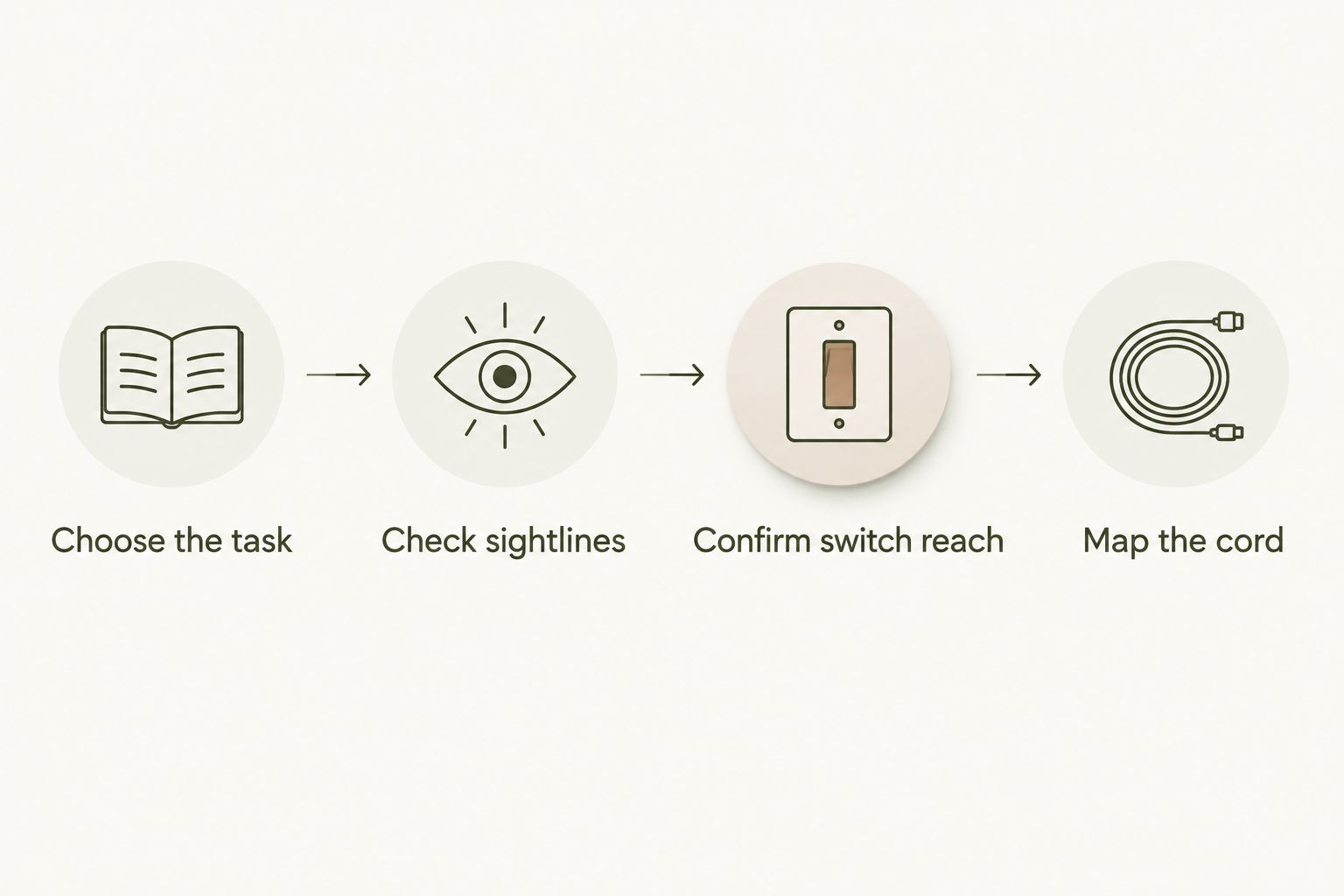
Treat placement as a sequence: choose the task, check your sightline, confirm switch reach, and map the cord route. Do this before making holes in the wall.
- Choose the task: Identify whether you need reading, background, or display light.
- Check sightlines: Sit or lie in your normal position and look toward the proposed fixture.
- Confirm switch reach: Check the actual control location, including an inline cord switch if specified.
- Map the cord: Trace the full route to the outlet without crossing a walkway.
Avoid routing a flexible power cord under a rug or through a wall. Follow the fixture's instructions, and ask a qualified electrician about any installation that changes the electrical connection.
How the styles are ranked
This 2026 ranking prioritizes useful light direction, comfortable shielding, reachable controls, and practical placement. Swing-arm sconces take the default position because adjustment serves changing activities; specialized styles follow according to their distinct jobs.
The ranking compares fixture types, not tested models. Lighthouseco wall sconce shoppers should use it to narrow the shape, then verify the exact product's wiring and installation requirements.
Which plug-in wall sconce should you choose?
Choose a swing-arm sconce if you are undecided and need flexible light beside seating. Choose a directional reading sconce for a dedicated bedside task, or a shaded fixed-arm fixture when soft evening light is the priority.
For Lighthouseco plug-in wall sconce shoppers, the best starting point is the activity the light must serve. Keep the outlet, switch, and mounting requirements on the shortlist alongside the style.
FAQ
What's the best type of plug-in wall sconce for reading?
A directional reading sconce is the best fit for focused bedside reading, while a swing-arm sconce suits changing positions beside a chair. Confirm that the head or arm adjusts in the direction you need.
Are all wall sconces plug-in?
No, a wall sconce is not automatically a plug-in fixture. Check the exact model's electrical specifications and installation instructions before choosing it.
Do plug-in wall sconces need drilling?
Plug-in wall sconces still require the mounting method specified by their manufacturer, which can include drilling. Plug-in describes the power connection, not a promise of damage-free installation.
How high should I mount a plug-in bedside sconce?
Set the mounting position around your mattress, reading posture, fixture dimensions, and switch location rather than using one universal height. Check glare and control reach while sitting in bed before marking the wall.
Can I hide a plug-in sconce cord inside the wall?
Do not route a flexible plug-in power cord through a wall. For a concealed electrical connection, ask a qualified electrician about an appropriate hardwired fixture and installation.
Is 2700 K or 4000 K better for a bedroom wall light?
Choose 2700 K when you want a warmer-looking bedroom light; 4000 K has a cooler appearance. Kelvin describes color temperature, so compare brightness separately and follow the fixture's bulb requirements.
Can plug-in wall sconces be used in a bathroom?
Use a fixture only where its manufacturer permits it, with the required suitability for the location and electrical installation. A household plug does not make a sconce appropriate near water.
One last thing
Check the switch before falling for the shade. A well-positioned light with an unreachable control is frustrating every evening, regardless of how good it looks.
Before choosing a 2026 fixture, rehearse the everyday movement: sit down, reach for the control, and look toward the light. That simple check helps you choose a sconce you will enjoy using, not just looking at.
Related guides
These related Lighthouseco wall-light pages offer additional styles to explore; confirm wiring separately rather than assuming they are plug-in models.
