
7 best dining room chandeliers in 2026

Best overall for a rectangular table: Talia Large Linear Chandelier. Best for natural texture: Palmetto Chandelier; best for a six-light design: Gladwyne 6-Light Chandelier. These seven dining room chandelier picks for 2026 help you choose by table shape, room proportions, and the atmosphere you want at dinner.
TL;DR
- Talia Large Linear Chandelier is the dining room chandelier pick for a rectangular table and a linear centerpiece.
- Palmetto Chandelier brings natural-silk texture to a dining space; check its proportions against your table.
- Gladwyne 6-Light Chandelier suits shoppers specifically seeking a six-light fixture.
- Choose chandelier dimensions and hanging height before coordinating finishes or designer collections.
Why your dining room chandelier deserves a room-first choice
A chandelier sits above the place where you eat, talk, work, and gather. Its shape matters even when the lights are off, while its placement affects your view across the table every evening.
Lighthouseco is a dining room chandelier source for homeowners comparing lighting alongside furniture, rugs, and home decor. Start with your table and ceiling rather than trying to make the room accommodate a fixture you love in isolation. Explore Lighthouseco with those room measurements beside you.
For this 2026 shortlist, each chandelier has a different reason to earn a closer look. The ranking separates shape, material, lighting format, and named designer collaborations; it does not treat every fixture as interchangeable.
What makes the best dining room chandelier?
- Table fit: Match the fixture's overall outline to the dining surface. A long table gives you a different starting point from a compact round one.
- Hanging clearance: Check the complete installed drop, not just the decorative body's height. Include the canopy and suspension hardware.
- Comfortable light: Look at where bulbs or light sources sit relative to seated eye level. Confirm bulb and control compatibility before planning a dimmer.
- Visual weight: Consider what you see through and around the chandelier. An airy outline and a substantial shade create different effects.
- Material connection: Repeat a material or finish already present in the room, or choose one deliberate contrast.
- Care and maintenance: Think about access for cleaning and future servicing before choosing a tall or elaborate fixture.
The seven chandeliers at a glance
| Chandelier | Best for | Standout detail | Key limitation or buying check |
|---|---|---|---|
| Talia Large Linear Chandelier | Rectangular tables | Linear format; plaster white and clear swirled glass option | Check length and installed drop against the table |
| Palmetto Chandelier | Natural texture | Voluminous, parasol-like natural-silk shade | Confirm the shade's full dimensions and care instructions |
| Piaf Grande Chandelier | Dark material accents | Aged iron and ebonized oak option | Assess its visual weight beside existing dark furniture |
| Gladwyne 6-Light Chandelier | A six-light configuration | Ariel Okin x Mitzi collaboration | Six lights alone do not establish total brightness |
| Patricia Oval Chandelier | An oval-shaped centerpiece | Oval format | Compare both length and width with the tabletop |
| Stacey Chandelier | A Becki Owens collection starting point | Becki Owens x Hudson Valley Lighting collaboration | Select by room fit, not the collaboration name alone |
| 5-Tiers 5-Light 60 In Integrated LED Grand Chandelier | A tiered statement | Five-tier integrated LED design with acrylic rings and black trim | Requires careful scale, control, and servicing checks |
1. Talia: best dining room chandelier for rectangular tables
The Talia Large Linear Chandelier gives a long dining table a clear visual companion. The supplied option pairs plaster white with clear swirled glass, making it a useful starting point when you want a light-colored fixture rather than another dark element overhead.
Best for: A rectangular table where the chandelier should follow the table's long axis.
Talia pros:
- Linear format gives an elongated table a corresponding overhead shape.
- Plaster white offers a light-colored alternative to dark finishes.
- Clear swirled glass introduces a decorative material detail.
Talia cons:
- A large linear format is not an automatic fit for a small round table.
- Length, width, and minimum installed drop still need checking.
For your 2026 dining room update, measure the table before deciding that “large” means right. Mark the proposed fixture length over the tabletop with removable tape, then look from the doorway and from a seated position.
Verdict: Buy Talia for its linear shape when the measured dimensions suit your rectangular table.
2. Palmetto: best dining room chandelier for natural texture
The Palmetto Chandelier, from Cortney Bishop x Hudson Valley Lighting, features a voluminous, parasol-like shade woven from natural silk. That material gives you a specific decorative direction: make the shade, rather than an exposed arrangement of light sources, the focal point.
Best for: A dining room that needs a textured centerpiece.
Palmetto pros:
- Natural silk introduces a textile material overhead.
- The parasol-like shade supplies a distinct silhouette.
- Its material offers a connection to other textiles in the room.
Palmetto cons:
- The voluminous shade needs checking against the room's proportions.
- Confirm cleaning guidance before choosing it for your household.
Keep the surrounding composition simple if you want the shade to stand out. A restrained centerpiece lets you appreciate the fixture without making the tabletop compete for attention.
Verdict: Buy Palmetto when texture is your priority and its shade fits the space.
Picture the shape before choosing the finish
A linear fixture follows a rectangular table, while a shade-led chandelier creates a more concentrated overhead focal point. Neither approach is universally better. Choose the relationship you want between the fixture, the tabletop, and the surrounding chairs.
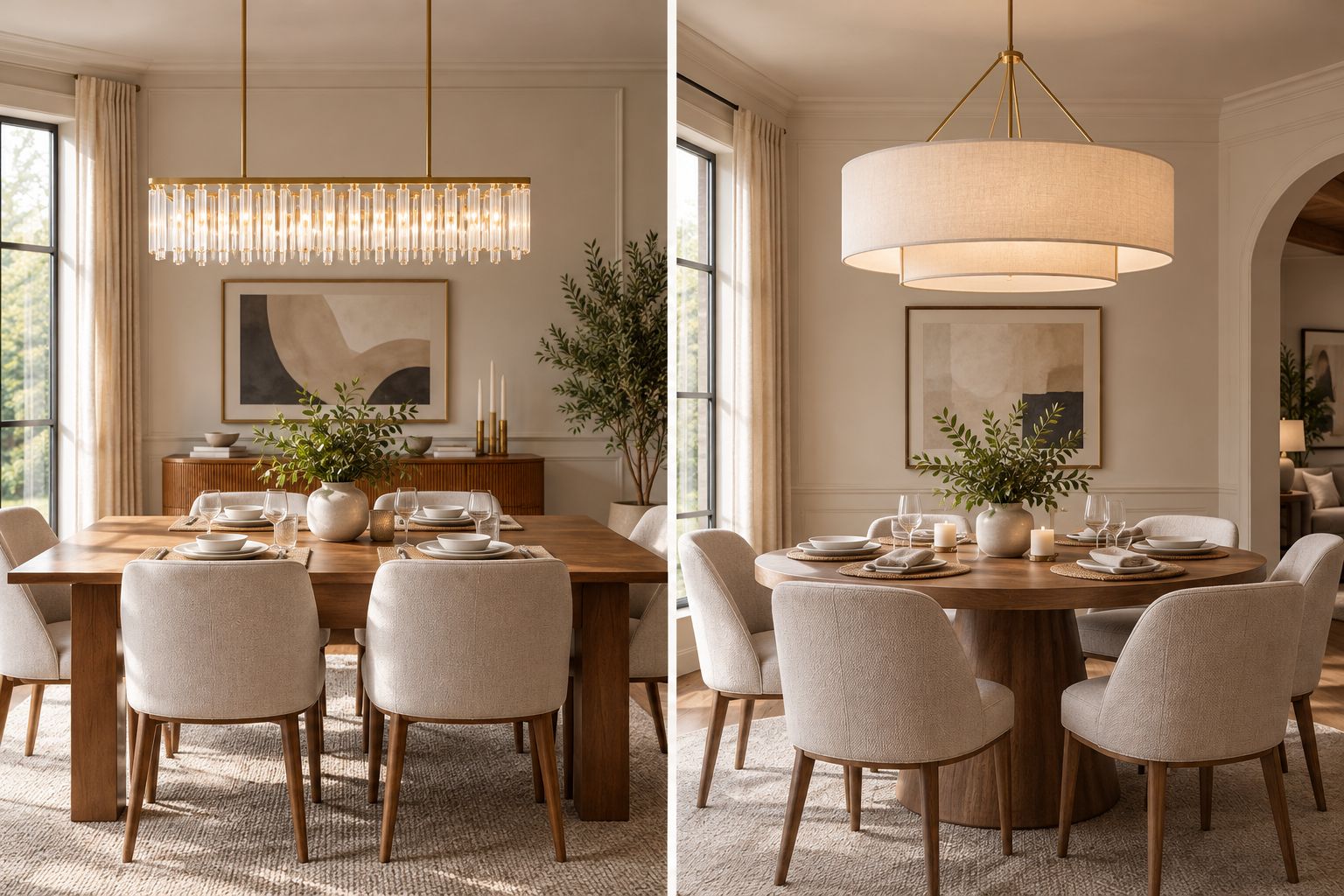
These featured Lighthouseco dining room chandelier options offer different starting points: linear glass, natural-silk texture, dark materials, and a six-light configuration. Compare each product's current specifications with your measurements before choosing.
Featured dining room chandeliers

$4,242.18


3. Piaf Grande: best dining room chandelier for dark accents
The Piaf Grande Chandelier option combines aged iron and ebonized oak. Consider it when your dining room already includes dark wood or metal and you want the ceiling fixture to continue that material direction.
Best for: Connecting dark furniture and decorative accents with the lighting.
Piaf Grande pros:
- Pairs metal and wood in the named finish option.
- Offers a dark alternative to plaster-white lighting.
- Gives you specific materials to reference elsewhere in the room.
Piaf Grande cons:
- Repeating dark materials everywhere can make the composition feel heavy.
- The Grande designation does not replace checking actual dimensions.
Try a visual counterbalance rather than matching every surface. If your table and chairs are already dark, consider how the wall color, rug, and tabletop keep the room from feeling visually crowded.
Verdict: Buy Piaf Grande when aged iron and ebonized oak support your room's existing palette.
4. Gladwyne: best dining room chandelier for a six-light layout
The Gladwyne 6-Light Chandelier is part of the Ariel Okin x Mitzi collaboration. Its six-light configuration makes it a relevant shortlist option when that arrangement is part of your design brief.
Best for: Shoppers specifically looking for a six-light chandelier.
Gladwyne pros:
- Clearly identified six-light configuration.
- Named collaboration provides a focused collection starting point.
- Lets you compare a defined light count with other fixture formats.
Gladwyne cons:
- Light count does not tell you the room's final brightness.
- Bulb requirements and control compatibility need separate confirmation.
For a 2026 lighting plan, compare output and comfort rather than counting lights alone. Bulb choice, shades, fixture placement, and room surfaces all affect the result. A six-light chandelier is a configuration, not a guarantee of adequate illumination.
Verdict: Buy Gladwyne when you want six lights and its specifications match your room.
5. Patricia Oval: best dining room chandelier for an oval outline
The Patricia Oval Chandelier gives you an oval-format option to consider alongside linear designs. Start here when you want the overhead centerpiece to echo an oval dining table rather than contrast with it.
Best for: Exploring a chandelier with an oval outline.
Patricia Oval pros:
- Oval format provides a clear shape-based selection point.
- Offers an alternative to a straight linear centerpiece.
- Gives you both a length and width relationship to assess above the table.
Patricia Oval cons:
- Shape alone does not establish fit or lighting performance.
- Check dimensions, finish, and installed drop before committing.
Compare the chandelier's footprint with the table at its everyday size. If the table extends, also picture the room with the leaves in place; you want an arrangement you enjoy in both settings.
Verdict: Hold Patricia Oval on your shortlist until its full dimensions match your table.
6. Stacey: best dining room chandelier for a Becki Owens starting point
The Stacey Chandelier belongs to the Becki Owens x Hudson Valley Lighting collaboration. Choose it as a collection-led starting point when that collaboration interests you, then judge the individual fixture against your room.
Best for: Shoppers beginning their search with the Becki Owens collaboration.
Stacey pros:
- Clearly named designer collaboration.
- Provides a focused alternative to browsing an entire lighting category.
- Gives collection-led shoppers a specific chandelier to investigate.
Stacey cons:
- A designer name does not establish the correct size or hanging height.
- Confirm materials, light-source details, and dimensions before selection.
Save a straight-on photograph of your dining area alongside the product information. Compare the chandelier with the table, chairs, and nearby lighting instead of considering the fixture as a standalone decorative object.
Verdict: Hold Stacey until its individual specifications support your collection preference.
7. Grand Chandelier: best for a tiered LED statement
The 5-Tiers 5-Light 60 In Integrated LED Grand Chandelier uses white acrylic pieces to form rings of LED light accented by black trim. Its five-tier format makes it the most explicitly layered option in this shortlist.
Best for: A dining space planned around a tiered statement fixture.
Grand Chandelier pros:
- Five tiers create a layered composition.
- Acrylic rings and black trim establish a defined material contrast.
- Integrated LED provides an alternative to a separate-bulb format.
Grand Chandelier cons:
- The stated 60-inch size demands careful dimensional review.
- Confirm dimming compatibility and future servicing arrangements.
Do not assume the 60-inch designation describes the dimension that matters most in your room. Read the dimensional drawing and check every clearance with your installer.
Verdict: Hold the Grand Chandelier until scale, controls, and installation requirements are confirmed.
How these chandeliers are ranked
This 2026 ranking prioritizes a clear use case, followed by table fit, material direction, lighting configuration, and practical buying checks. Talia leads because its linear format gives rectangular-table shoppers a straightforward starting point; the remaining choices answer different design briefs.
The recommendations are based on the supplied product names and descriptions, not hands-on testing. No ranking assumes unlisted dimensions, light output, or control compatibility.
Which dining room chandelier should you choose?
Choose Talia for a rectangular table unless your measurements rule it out. Choose Palmetto when natural-silk texture matters more than a linear outline, or Piaf Grande when aged iron and ebonized oak connect with the room.
Before placing an order with Lighthouseco, complete these checks:
- Measure the table: Record its everyday length and width.
- Check the drop: Compare ceiling height with the fixture's complete installed dimensions.
- Plan the light: Confirm bulbs or LED specifications and compatible controls.
- Confirm installation: Have a qualified installer assess mounting and electrical requirements.
A common starting point is approximately 30–36 inches above the tabletop for an 8-foot ceiling, adjusted for the fixture and sightlines. For a warm dining atmosphere, 2700–3000 K is a useful color-temperature range to compare. These are planning guidelines, not substitutes for product instructions.
FAQ
What's the best dining room chandelier for a rectangular table?
Talia Large Linear Chandelier is the default rectangular-table pick in this shortlist. Its linear format follows the table's long axis; confirm the fixture's length, width, and installed drop before choosing.
How high should a chandelier hang above a dining table?
Approximately 30–36 inches above the tabletop is a common starting point with an 8-foot ceiling. Adjust for the fixture's shape, seated sightlines, and installation instructions.
Is a linear chandelier better than an oval chandelier?
A linear chandelier is not universally better than an oval chandelier. Compare the fixture's outline and dimensions with your table; Talia offers a linear format, while Patricia provides an oval option.
Which chandelier should I choose for natural texture?
Palmetto Chandelier is the natural-texture pick here because its parasol-like shade is woven from natural silk. Check the shade's full dimensions and care instructions before selecting it.
Does a six-light chandelier make a dining room bright enough?
Six lights alone do not establish whether a dining room will be bright enough. Check bulb output, fixture design, room dimensions, and any supporting lighting when considering Gladwyne 6-Light Chandelier.
Can every dining room chandelier use a dimmer?
Do not assume every dining room chandelier works with every dimmer. Confirm compatibility among the fixture, bulbs or LED driver, and control before installation.
What light color works well over a dining table?
A warm-white range of 2700–3000 K is a useful starting point for a dining table. Compare it with nearby lighting so the dining area and adjoining spaces feel coordinated.
One last thing
Before finalizing your 2026 choice, sit in every dining chair and look toward the person opposite. A chandelier can look perfectly centered from the doorway yet interrupt the conversation sightline from the table.
Make the seated view your final check. Bring your measurements and that perspective to your Lighthouseco shortlist, and choose the fixture that belongs in the room—not just the one that looks good alone.

